It seems I am gaining followers here every single day.
This invokes an immediate reflex to check out exactly who is following. The numbers of followers who are already published authors, have a book in the hopper—or both—is staggering. And encouraging.
I’ve bought a couple of them, too.
I’m looking forward to the day I can post that crucial avatar—that one critical piece of referential iconography that makes feel I’ve been transformed from a bill—into a law: The book cover.
I’ve sat around, chomping on my plot, setting, conflict, resolution and continuances. But, like any good visionary—I’m starting to hanker for some representative visual canvas upon which to throw my paint.
I’m going to design—at least for now—a book cover for a book that does not yet have a complete existence.
Since Photoshop’s complexities are indecipherable without direct guidance, I did what any good, academically-inclined armchair intellectual borne of classical pedagogy would do.
I went to Youtube.
This technique served me swimmingly when I made my epic fly-fishing film. Even my narration hails the acumen of the “upstart-15-year-olds” that made it possible for this cinematic infidel to skulk the catacombs of Adobe After Effects.
This allowed me to composite a non-existent UH1 Helicopter into my film, giving the impression that I had some big-budget transportation windfall, and got dropped off in the middle of nowhere.
This also allowed me to make it seem like a hostile missile attack had blown up a bridge on the Upper Sacramento River, all while I continue fishing in spite of this annoyance 150 feet away.
I’m not exactly sure I will be the final designer for my own cover, but I will at least wield the conceptual gavel.
I’m actually considering something slightly more radical: There is a musical artist—a fairly well-known-one that also sells paintings from time to time. This individual might actually want to be commissioned for this, once they hear the sum total of the atrocity I’m about to foist on the literary community.
I know it sounds like a pipe-dream. But I’ve managed to have a few of those realized before, so don’t count me out on that.
I’m hoping enough of the writers I’ve mentioned get this far into my little rumination to answer this:
What exactly WAS the process for you—of arriving at a cover you felt cast your book in the appropriate light?
In a few minutes, I’m going to lay forth what I refer to as a deliberate experiment in banality. And I’m going to use as my case study, Mr. Big’s hit song, To Be With You as my central creative canvas.
But first, Let’s talk about the uber-talented author and singer of said song, Eric Martin.
This is a picture of Mr. Voice himself:
Compare this to contemporary Sherlock protagonist, Mr. Benedict Cumberbatch:
That’s all I’m sayin’. Something’s up people. I’m not sure his tour schedule bringing him through a protracted UK arc is telling us what’s up. I know I’m suspicious.
As an aside, I got to play alongside him in 2006, where he treated me as an equal, and came to some odd conclusion that I actually know how to play guitar. After he reads this, he may want to rethink ever extending that hospitality again. I simply cannot be trusted when it comes to fooling around with the creative bedrock of other people.
A brief history of messing with other people’s creative bedrock
Many years ago I was flailing away in the half light of auto-detail/working musician livelihoods . You know the deal—a young, vibrant and overbearing, quirky talent, getting ready to run on to the world field, but still swinging two bats in the dugout kind of half light.
While playing a guitar on some dubiously-fortified nightclub stage, no one ever walked up to me and said, “Hey brother, I heard you detail cars. Any way you could come over tomorrow and help me mitigate these unsightly water spots from my driver’s-side windshield?”
Nope. Not once. No glory to be found there.
Conversely, being the resident long-hair at this particular auto dealership in the 90’s had the same invitational hallmarks as being a nurse at a hypochondriacal Burning Man festival; every car salesman needed to vent their spleens about some adolescent-era dream of “wanting to play guitar.” Or–they wanted something worse.
They wanted help working on a “song they wrote.”
Time and time again, I helped these folks along, and sometimes with some degree of success at the level for which they were hoping. But once in a while, the request was so appallingly tone-deaf in its concept, that no amount of noodling, tweaking, rearranging and augmenting was going to prevent an impending train-wreck even a nearsighted Nostradamus could’ve seen coming.
That wasn’t the problem. The problem—was culling Casey Jones out of the engineer’s loft.
One automotive luminary approached me in the parking lot to inform me he had struck inspirational paydirt—with an idea that bridged:
my musical chops
modern rap
a 60-second radio ad for the dealership that would contain these “sweet flows” written on the lined paper held in his hand.
Worse that that, he went ahead and “rapped” it for me while I tried not to lose continence. Mind you, this man’s level of musical caucasus was a strata that was so undiluted, that it literally walked the sidewalks of Rhythm and Harmony with a sandwich board that reads, I clap on the one and the three when that ditty gets going.
I simply couldn’t take it, what with him alliterating his Rs over and over again. I almost had him shanked right there for making me want to hear an accordion instead. I literally wound up leaving that job before he and his inspirational Rasputin finally got shoved under the ice in a bullet-ridden trauma.
The one day, I read this story about a cruse ship called the Norwegian Dawn that has some rough water that splashed over the edge and scared a few folks. By the time the pulled into an alternate port, the uninjured,and slightly put-off passengers walked off the ship comparing themselves to Titanic survivors.
Not being able to take it, I decided to blog my own mockery about the matter by rewriting Gordon Lightfoot’s Wreck of the Edmund Fitzgerald to draw the ridiculous highlight between an actual horror, and a comparative non-moment, by taking their mundane high-seas sagas and encasing them in the sacred rhymes of Lightfoot’s recap.
And it was fun. Reductionist potshots and the abstract transmogrification of known quantities is fun.
Speaking of known quantities, let us familiarize ourselves with the one-of-a-kind dulcet-tones of Mr. Martin, and his circa-1992 band of virtuosic ruffians, Mr. Big:
Aside from acknowledging that the man’s chromosomes must look like a bopping Kids Unlimited chorus under a microscope–one must–MUST be familiar with the rhythmic underpinnings and lyrics to even appreciate the atrocity I carved out last night.
That being said, I wax:
“To Be With You,” translated out of it’s pure, poetic longing, and mercilessly clawed into sleep-inducing, literalist gibberish
Verse 1
Admonishment to stop
and recall all his list of wrongs
Encouragement to stand
a once-removed heartache statement
a Circular truth claim
a bilateral claim that fate will maim
Petition for nearness
With positional focus
permission to be the one to show this
Chorus
Statement of desire to close the gap assumptions that is where the other person’s at reference to a queue of psychedelic mats to underscore desire to close the gap
Verse 2
A plea to undgergird
that makes one like the early bird
point made that open eyes dismiss
a toddler lad that likes to diss
Eye witness to love’s flame
and it’s anaolgy to a baseball game
Bridge
Singlehood is compared
To a two-as–one and found wanting
Another raising life’s net worth
in return a note of a smile’s birth
So you ask me. Mr. Writer-Man, why in the world would you do this? Why do you feel the need to drag a perfectly-written, perfectly recorded piece of musical history through your dopey, opportunistic prism?
I’ll tell you why. If anything it proves that substance and expressive power are sometimes intangible. Lyrics such the ones in this relatively simple song are deceptively deep–and cut a much broader cross-section than my literalist tomfoolery tries to distill.
What I’m trying to say is: In failing, I have thus succeeded.
It’s greater than the sum of its parts as they say. And I’m going to tell him that when I see him.
I was a real wiseacre in the 1990’s. Shiftless, malcontented, and always looking to see if I could get people to reflexively answer stupid questions like,”do these stairs go up or down?”
When I managed to ferret a circa-1940’s typewriter out of a thrift store, I simply saw in it potential; I can move mountains. I can summon the Kraken from the nether-worlds.
I can also bait KFC into a goofy, proprietary defensive posture:
Click to enlarge
I know. I come off as the heretofore-mentioned wheel-short-of-a-bearing. But remember, all I was really looking for was the entropic output of the administrative department.
I wanted a direct response. At least I got them to look me in the eye:
I say this because It’s been a long day, in which yours truly does not feel good. It’s a day that encompasses fatigue, annoyance, and a general internal consensus that I am becoming psychologically staged for some real life-changes.
This also means struggling with inspirational turns. Such as today–if it weren’t for some cumbersome millstone of “writing every day” for the first year at least, I perhaps would’ve just crawled back into my overtaxed, ruminatory mind’s eye and called it a day.
It did occur to me to write a couple of trolling letters, to see what would happen. In fact, I’m not sure those guys at the Cupertino Apple factory will think I’m joking; they might actually have to pay me royalties for my stupid idea.
More on that soon. I have an epic rant that led me to write the letter. The idea, of course is not to come off like a complete crackpot–just mildly disoriented with potential–kind of like Susan Boyle on Britain’s Got Talent.
I’m not really sure if I can attribute a precipitous drop in reading acumen to my mere 47 years on the earth, but I can certainly foment a personal paranoia about it.
This is partly because I extruded some coffee out of my Kuerig coffee maker the other day, and instead of grabbing the squeeze-bottled, liquid sweetener called “Organic Blue Agave,” I grabbed the LITERALLY blue dish soap and laid it to waste.
On top of that, I forgot to use the casing for the filtering screen when I did make the coffee, and thus poured out a ridiculous amount of grounds–that would’ve ruined my morning ritual anyway, the minute I took a sip.
My wife immediately starts some sort of understated, prognosticatory dissertations about “brain tumors,” and such. I didn’t laugh at this. Probably because the malignancy is pushing on my humor lobe.
Now, I have friends that will tell me that I can offset the Blitzkreig of this invasive, fibrous neoplasm by knocking off the near symbiotic use of my Iphone—but only if I make the compensatory behavioral pivot to green smoothies.
The advent of the omnipresent “screen” has changed everything. And while this little post will not be footnoted with research material, it still should at least stand amongst the also-ran pillars of what is a little-known concept known as “common sense.”
Without a doubt, screens are recalibrating our minds, our interactions, our relationships—and even our physiology. The recent story of a man whose extended use of a smart phone in the dark has resulted in a detatched retina should give one pause. Clearly, that guy has a problem, we say. Clearly that man has crossed a line of addcition to a point that we can only stand and watch.
Even worse, the guy was probably looking up invasive brain tumors on WEB M.D.
But really. It started to hit me that I do not have to be glued to my Iphone in perma-scroll mode to have viable, adverse issues. One of the reasons I do not play video games is because I have an actual—though undiagnosed—neurological malfunction that causes my hands to shake. I literally had to stop playing Super Mario Bros., WII Edition because of this. I simply, overtly, and materially—cannot do it.
Yet, I’ve been staring at, navigating, clicking and scrolling on screens for years, reading blogs, news quips, emails and synoptic rundowns. All with zero tangible cognitive resistance. Plus, I’ve watched Bruce Jenner’s face transmogrify into a time-lapsed, erstwhile Michael Jackson in the advertising margins.
That’s right. This thousand-yard-stare has legs.
So I am certain that my hippocampus is cowering in the corner, afraid that it will be forced to read something that doesn’t contain some snarky, backlit Cliff’s Noted trilogy without a scroll option. And that will have to be the expurgated version. Thank you.
I can write with almost no aerodynamic resistance. I can re-read what I’ve written, but I assume that I’m either a narcissist, or that I’m already 9/10’s in the game, since my review deals with clarification, and not comprehension.
I’ve tried to read Strangers in the Land by Stant Litore on my Ipad. I’ve tried to read Peace Like a River by Leif Enger on my Nook. Both of these books are hailed by people I respect as some of the best fiction on the planet. Yet, I CANNOT—get off the Launchpad. I can’t even be as cognitively pathetic as the Spruce Goose—I don’t even get a disastrous maiden flight.
I figure, since I’ve already diagnosed myself somewhere between the margins of a cerebral cuttlefish and a neurological neuter—I may as well do my own labs.
I grabbed my Iphone and took a picture of my Nook, and sent it to my Ipad.
Page one: read and savored.
I screen shot my Ipad, and sent it to my phone.
Had to zoom in and move around, but for some STUPID reason, I am into chapter two.
Of course, I had to delete pictures after a while. And of course this led to me hitting my Safari icon to “check the news.” Then to my traffic stats. Then, I have to approve new comments on the blog. Off to emails, and FaceBook notifications regarding this blog—and then the slow, gradual descent into Sheol.
Next thing I know, my cerebellum is wandering around the desert like The Eagles on a photographic jaunt with a peyote-button after-market addition.
The person that can invent a “patch” that will replace whatever figurative electrolytes are lost to all this will be a millionaire overnight.
Until then, I’m taping a Nook to my arm when I go to sleep.
Note: hat tip to Jodie Llewellyn for the term “Reader’s Block.” I told you it’d pay off.
Technically, I’m loosely siphoning this bit of inspiration from my FaceBook feed. And since it’s most likely situationally viral, it may be no surprise to any of my followers either.
I have no idea HOW–his last statement in this video never managed to penetrate my pachydermatous common-sense PCU, but I’d come close to swearing up and down this is the first time I’ve ever heard it–or at any rate heard it expressed this succinctly. And quite honestly, I’m at a transitional phase in my own life; I simply needed to hear this today.
I’ll grant him a theological handicap for his all-encompassing, metaphysical jargon. And I’ll also avoid pointing to his odd, videographic-and-borderline-creepy swoons of bête amour.
It’s 110 degrees outside right now. You’d think I’d be used to it, as my quasi-indigenous upbringing would allow me to move past an attitudinal Jurassic age and just let Lethargus Rex go extinct.
But I don’t. I’m laying about like some demotivated manatee.
I started to follow-up on my previously-alluded-to “reader’s block” affliction, but I demurred.
I stated to write about two 90-plus years-old men that managed to show up to Omaha Beach on June 6 in the most unlikely of ways, and then draw a scathing comparison of them to the beta-male, brace-wearing, I-just-sustained-an-OJI-from-trying-to-jump-on-the-gravy-train redshirt consortium in which I find myself these days.
But I twisted a hoof when the gate dropped.
Then it hit me. I’ve already sat around for hours, noodling Adobe After Effects, and in reality, crafting a veritable celluloid metaphor for this entire, appallingly anemic post:
We have not the reverent feeling for the rainbow that the savage has, because we know how it is made. We have lost as much as we gained by prying into that matter.
Mark twain – A Tramp Abroad
In recent weeks we’ve been treated to the whimsical and slightly fascinating escapades of a purported millionaire leaving envelopes of money hidden around the bay area. The individual was anonymous, and took to a Twitter account to run the next set of clues—setting people looking. Looking because it’s fun to look for clues, and also because it’s fun to get money.
This resulted in all sorts of whimsy—people running around the San Francisco Bay area, finding the “loot” as it were. The mysterious philanthropist mostly implied he was doing it as some sort of recompense for the nature of the housing turnover business in which he was involved.
And so you have it: Masked man. Loot. Mystery. Enshroudment. Seeing through a glass, darkly.
But not now. He has now been outed by sheer technological advantage. Not content to simply leave the veil hang to prolong and allow for the acceleration of wonder, some type-A Gladys Kravitz had to come along and yank off Santa’s beard—all by using a complex, audiological comparative voice program that matched his voice to that of a housing agent.
Good job, Adrian Monk. You’ve yanked off Zorro’s mask. Now all we have is Antonio Banderas and ZERO purpose to stare at him now.
So, because of the exhaustive, voice-analysis results of this prattling, OCD wet blanket–at the behest of Inside Editon, the man has come out and admitted he is indeed–the mystery guy.
Mystery over. And the best part of the game–ruined.
This cumulonimbus cloud of stupid clearly isn’t the first— or the last ankle-high Toto with a fetish for invasive and caustic curtain pulling we’re going to see. Nor is he the most irritating. But there is—and I don’t know why—there is a side to me, and almost yin-to-yang sort of compulsion, creeping amongst the hallways of latency—that wants to walk up to these people and punch them right in the mouth.
And yes, it would feel good to hit them.
We. Need. Mystery.
Trying to decipher things like the Jeffersonian codes is different, albeit no less disappointing when they wind up cracked. But the code itself implies the game is about the revealment. The philanthropic money maven wasn’t daring people to out him—he was egging them to find the money.
Yet, Scooter Computer, not content to simply fish, has to drain the entire pond to find that trophy. Meanwhile, no one else gets to fish while this nefarious nether-troll rolls up a giant joint of self-congratulation, and smokes it beside the now vacant bank.
But really. I perhaps kick against the thorns of commonplace culture. If we can’t know it all—now, we want no part of it. People can barely stand to watch anything in piecemeal form. They’d just rather sit up for three days on a manic-depressive Red Bull marathon watching all 192 episodes of 24. Sure, you might find yourself on and aerial CNN feed with an automatic weapon, but at least you didn’t sit around and wait for some loose-lipped roustabout co-worker to tell you what happens to Jack Bauer.
Google hasn’t helped hobble our debilitating need to have the comprehensive rundown. Ditto for Wikipedia.
There’s a reason J.K. Rowling needed her upcoming releases of Harry Potter kept under armed guard prior to the release: because she understood that ONE wayward book in the hands of some itemizing, web-saavvy idiot savant with a secondary Tourette’s broadcast tick–would run right out and barf out the denouement in thirty minutes–probably because he also has some odd speed-reading synesthetic “Gift”on top of that.
Even more importantly, this is the same reason I put safeguards around my children. This is why I do not have a viable television signal in my house. The unfiltered and unmonitored world of television takes on the role of Great Mystery Destroyer. We were not designed to know the sophistications of the world in comprehensive form by the time we’re twelve. Trust me. I work with that demographic. It was bad enough when the last episode of Lost had people my age feeling hopeless and depressed on FaceBook with their dopey and unrealized suicidal ideations. Imagine what it’s like for the contemporary adolescent these days–when every single screen they see in their life is like a giant, inanimate street flasher–removing every single mask from every single mystery.
Turns out, I’ve nailed myself to an obligatory wheel, insofar as I have committed myself to writing every single day for the first year.
Yesterday was a confluence of many cool things. One was the Victor Wooten clinic in San Rafael, Ca, yesterday. The other was an encouraging phone call from someone I did not expect to receive a call from. At all.
Today, I feel like someone has shoved a fermenting gym sock into the middle of my head with a broom handle. Maybe it’s because I drove eight hours. Maybe it was all the preemptive Red Bull front-loading I did, since my proclivity to plow into the Grand Narcoleptic Sea while behind the wheel is so imminent. And maybe I have a brain tumor the size of a midwestern grain silo.
Not sure if I can drag out the micrometer, and T-square to define whether or not a chasm exists between what I’m describing, and the pedestrian trauma of writer’s block. But I do know this: I’m certainly not suffering a dearth of commonplace angst, unoriginal gripes, cliched carping and boilerplate caterwauling about not really having anything to say.
But as far as the subject of NotHaving Anything To Say–I guess now I’ve proven that, at least to that end, I do have something to say.
I have a tremendous facility for the vacuous. The inane. The banal. Even in the horrid delirium tremens of writer’s block, I can at least lay in a traumatized fetal position, excoriating my epiglottis with intolerable bellicosities–all in the name of some literary void. Sort of an anti-detox. Give me something to supplant nothing.
Tomorrow, I plan to address something about which I heard another blogger jest:
NOTE: I’m writing this knowing full well that I will be heading to San Rafael tomorrow to see Victor Wooten. Thus the subject is presently at the forefront of my mind.
Having first picked up a guitar at the age of thirteen, and now being 47 can give one a real seenitbeentheredonethat sort of underpinning–even if it isn’t a conscious decision to be that way.
And it’s not everyday that something comes along that truly illuminates elephants in the room that NOBODY–not ONE musical influence,teacher, mentor, or arms-length inspirational point-of-departure ever seemed to circumscribe.
I met Victor Wooten some years ago when he played my town under the moniker of Bela Fleck and the Flecktones. Mr. Wooten’s bass chops have been legendary to me from the day a friend tossed me a cassette of their album, Flight of the Cosmic Hippo from the cab of his tow truck.
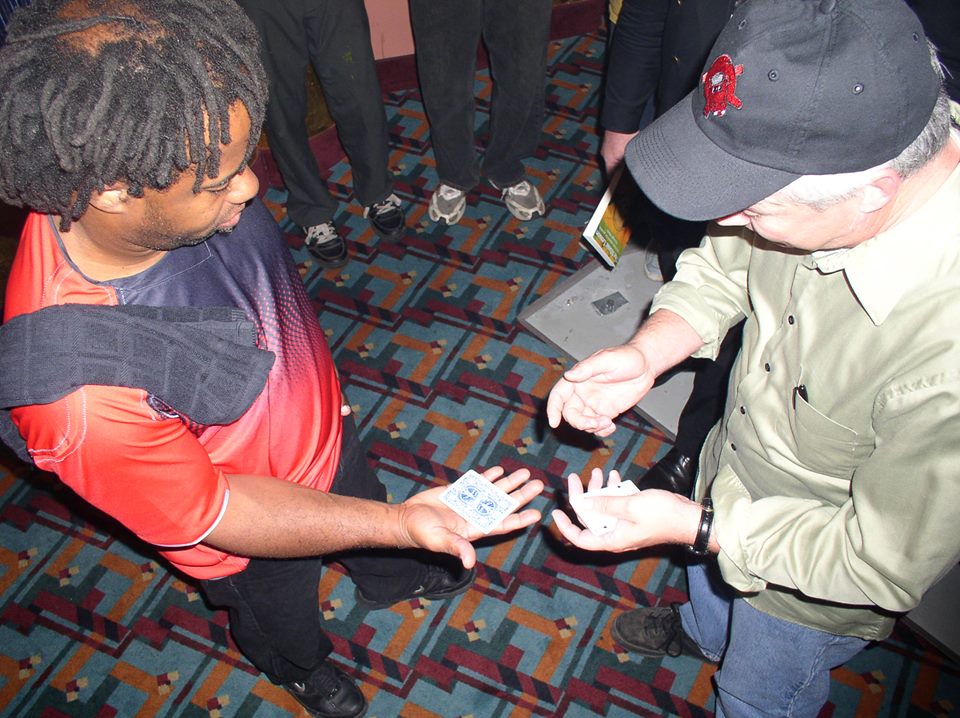
My friend, Chris, says, “I’m buying his book.” Me? I was so enamored with getting to meet this man (and ultimately wound up performing card tricks for him) that I took no notice of his related literature. I was too hung up on technique. His technique.
Now all these years later, I’m researching the ukulele at Live Ukulele, when I see in Brad Bordessa’s reference list of musical furtherance materials, Victor Wooten’s The Music Lesson.
So I bought the book.
I was already familiar with Wooten’s doctrinal stand on the nature of music–all laid out at his renowned TED Talk presentation–on his insistence that music is a language.
Now before anyone decides to bail on this piece in the half light of such a pallid overuse of the term and phrase, “Music is a language,” please listen to Victor’s position. he doesn’t just mean that it has communicable ability. He means it has the same developmental requirements any language must have in order for a vocabulary to build.
Think about this: You were using verbs and adjectives before you understood what they were. Your vocabulary was built by your exposure–or lack of exposure–to adults. If you were present in the room when the adults were holding forth on subjects with multi-syllabic, colorful and robust communication avenues, you were likely to not only understand it–you were likely to repeat it.
Now think of what your vocabulary would be like if it had been subjugated to some isolated little nook in which you were only allowed to speak to your peers. Get it? Your young vocabulary took on an exponential arc precisely because you were not confined to a beginner’s vocabulary class.
You became articulate because you were–as Victor says–allowed to “jam with professionals.”
And thus,the book begins with this same worldview. His pep talk alone on that will make one palpably excited about learning music.
Or teaching it.
The book chronicles a visit by an existentially-dubious character names Michael. You really are not sure Michael exists, but ultimately it is of no consequence. Michael goes on to elucidate the eleven things music teachers almost never teach–or at any rate teach a separate-yet-equal cogs in the musical wheel:
Groove
Notes
Articulation/Duration
Technique
Emotion/Feel
Dynamics
Rhythm/Tempo
Tone
Phrasing
Space/Rest
Listening
Without broaching the entire work, we’ll examine the importance of Groove for now.
Wooten’s work maintains that finding the groove in a song is infinitely more important thank knowing how to play anything IN the song. He cites his own exposure to his older brothers–who were also musicians. Even though he was handed a bass as a little kid–he didn’t play bass on it. He played percussion. Before too long, he had established a groove that set him apart as a legitimate musical broker. Even though he didn’t yet play bass.
It wasn’t about playing bass; it was about making music. TWO–different things. Two very different things.
That chapter alone focused my awareness to musical approach. Then, I saw it. We are designed to maintain the groove over and above our commitment to lyrics. I’ve recorded scratch tracks in the studio for years. I’ve sung dummy lyrics onto a track to maintain a continuity and conceptual framework. THAT–had to do with groove.
My granddaughter ran through the kitchen the other day, singing the alphabet song. At two and a half, she weaves in and out of concern for all 26 lyrical stations:
“A B C D E F G . . . .H I J K, uh dub uh dub uh dub. . “
Right on time, she was. She bailed after K, but for the life on me, her timing on that baby-skat rundown was perfect.
Bailee had the groove. She didn’t realize it,but she was committed to the preservation of the groove.
I could easily lay out 5,000 words about the book, but I will not. I’ll leave it there, save for one more “ah-ha” moment. If you walk over to the piano and play 8 white keys backwards, stating with middle C, you will have played a banal and boilerplate descending C-major scale.
Put a pause after the first, fourth seventh and eighth notes while doing it,and you’ve played the first phrase of Joy To The World.
“It’s not the notes, you play,” Says Victor. “But the space between them” that makes the difference.








 Box Number Seven