
Now Steve, you didn’t really expect depth from me, did you?
 I happen to be lucky enough to live right near a used bookstore that is a literal BEHEMOTH of a bookstore–I’m talking about the acetone-ridden aircraft carrier with sticks and stacks of shelves . . . two-books deep sometimes, with the perpendicular stack accommodating the surplus. The front desk near the old frontage building is PILED with new intakes and trade-ins.
So I waltzed in there looking for any wayward CS Lewis material and also a tactile edition of Flannery O’Connor’s A Good Man is Hard To Find. I managed to find the latter, along with an old version of Reflections on the Psalms.
Since I was in the literature section, I always scrape my eyes over the Mark Twain stuff, always hoping that they’ve accidentally shelved a first-edition copy of anything of his. I found three different edition of my favorite of his books, The Innocents Abroad. I also found three different edition of Lewis’ Mere Christianity.
Then this thought occurred to me as I flipped through each edition, getting a “feel” for them. I wonder if the experience is in any altered by the changes made in placement, typesetting, and binding?
I have a 1902 copy of The Innocents Abroad–already 113 years old and still a copy published a generation after it first saw the light of day. But the copy is replicate of what it was when it was first released. In other words, the copy I have is exactly the presentational paradigm Twain was looking at when he was alive.
The first time I read the book was an odd library copy. Then, I bought a soft-bound Barnes & Noble edition (two of which I’ve lent to others and never got back–POOF!). But I’ve never read it in the original tactile form.
I begin to wonder if I’ve lost something by not doing that. That maybe a magical turn, nuance, joke, or witticism in another edition is lost to strategically-awful placement and typesetting.
I’d love to hear your theories on this.
The problem with cynicism is its ability to make me seem like a clairvoyant. My nearly-superfluous understanding of my fellow man’s entropic tendency towards cowardice, selfishness, and situational greed gives me the appearance of prescience. When in reality, it’s the easiest thing in the world.
So the inner conflict arises to the ego, when others cannot simply see the ridiculously-clear writing on the wall, to be seen as some modern-day Kreskin—or some other, cold-reading mountebank ascribed with paranormally refined abilities to “see over the dashboard.”
I’m going to share with you my secret:
1) In environments where one can be paid the same hourly sum for not showing up at a stressful job as actually showing up, a large percentage of internally-vacant people will opt for the first.
2) Those opting for the second will be expected to take up the slack for those opting for the first.
3) I simply identify the people in group one and predict their exit at the most crucial of times, holidays, and Superbowl Sundays.
4) I am right. Again and again. Like a slot machine paying me in slugs.
5) I am NOSTRADAMUS.
Blogging is going to be schitzo.
A matter of getting the observational tripe in between breaks.
So you’re spared the magnum opii of nonsense for now. And especially made-up Latin plurals.
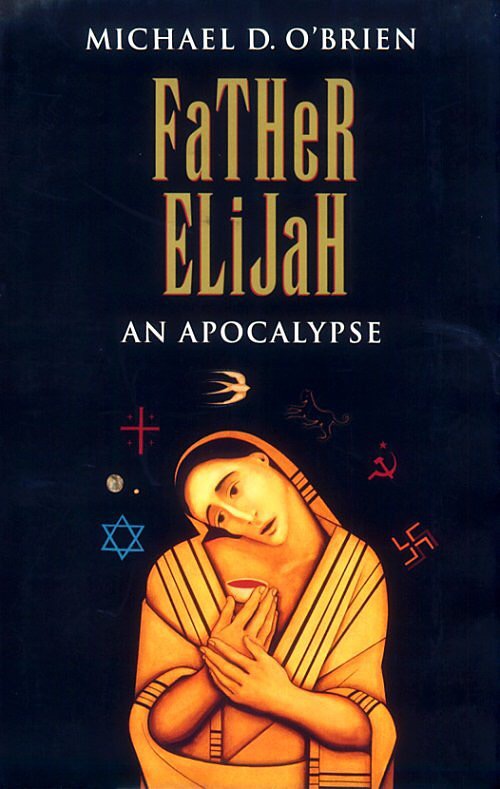 At the outset it’s become clear that I’m not going to find even the most palliative help for my literary schizophrenia.
Turns out, I’ve started this book, Father Elijah, about four times. But my exposure to the blue-screen, brain-freezing iphone makes me jittery when I grab a book.
That’s not to say the book is boring. It isn’t. I just wasn’t ready to commit, I guess.
So . . . just for the record, this will be my literary pursuit for now. At least the fictional one. I did manage to also hedge myself against my own “one book” policy by diversifying my doctrine into fiction and non-fiction categories.
I know. I know. Neurotic.
So now comes the tug-of-war for my synaptic dedication. I’ve already managed to pull five or six books off the shelf, assuming this one to be the one I’m going to read next. And trust me; there is no rhyme or reason to the quandary.
One more word about Leif Enger’s Peace Like a River. As I’ve already said, I simply cannot “sum up” a book that has this kind of resonating depth. But I have rarely been “haunted” by a piece of fiction like I have with that one. And by that term, I mean in a good way . . .
So my shelf is yelling, thus:
Sherlock Holmes, The Complete Stories by Arthur Conan Doyle
Miracles, by C.S. Lewis
Strangers in the Land, by Stant Litore
Orthodoxy by G.K. Chesterton
The Complete Stories, by Flannery O’Connor
The odd thing is, I’ve read some of these all the way through, years ago. But age and supposed wisdom of the here and now presupposes that I missed half the game the first time around.
As for the Sherlock Holmes novels, I was pleasantly surprised to discover that, like the BBC/Benedict Cumberbatch adaptation of A Study in Scarlet (reconfigured to pink in the adaptation), that the first tactile presentation of Holmes was kept intact—that he truly WAS eccentricly beating on corpses in the morgue for forensic pursuits.
So my rationale for reading them is for comparative purposes—to see if Steven Moffat has maintained some integrity throughout the extant nine episodes.
Strangers is simply me taking the next step in Litore’s Zombie Bible series, and the Flannery O’Connor stuff will be read if for no other reason than to finally have all the reference points within them my good friend Steve makes about them. Besides, I’ve somehow gotten this far without having THE avatar for southern grotesque catholic literature ever making her way through my brain. It’s time.
And for the record, C.S. Lewis will always be in my rotation. He’s the best there ever was. And I’ve already said essentially the same about Chesterton. I’ve said before, if Twain and Lewis were tossed into a hay-bailer—Chesterton would come out on the other side.
 I’m not even sure what I’m supposed to say here. I’ve been taken on an emotional, territorial, regional, and spiritual ride all at once. I’m actually not going to to wax too profuse here, because really, this book is one that simply needs to be read to understand it.
This isn’t to say it’s abstract, or hard to understand. Let me put it this way–I have, for the last week and a half, tried to do that at which I am extremely good in person: summing up a book in “blurb form” for others.
This one is just too . . . um, see, I can’t even think of a word. Complex does not work, even though it is. The closest thing I could say about it is multidimensional.
That said, the overview is thus:
Reuben Land is an eleven year old Minnesota kid, living in the 60’s. He is born asthmatic. The first thing you encounter, as a matter-of fact, is the “1st person omniscient” recounting of his own birth–one that should have left him and his clogged lungs dead at birth. Over the scientific pessimism of the doctor and the situational agnosticism of everyone else, Reuben’s mysterious father runs in, commands him to “breathe in the Name of God” and causes him to live.
“This,” says Reuben, as the “first miracle” he saw his father do.
A series of subtle-yet-inarguable miracles take place. Some of them overcoming the impossible while other impossible circumstances are simultaneously unfolding around them (and by them I mean his father, brother, and precocious little sister, Swede, who has a MAD literary streak). Reuben and his compromised lungs see some serious miles, both logistically as well as experientially.
And as much as I hate to say it, this will technically go down as the worst book review I will ever forge, because I am stopping there. That description is neither complete, nor telegraphing in any sense of direction. In short: if you want any advice from me–read the book yourself.
A perfect novel can be forged against the single backdrop of relationships–something that, if done correctly can make the entire story feel complete, and without a single implied omission. And this is no mean feat.
Enger manages to do that here, but adds–no WEAVES–fourth dimension to it: meaning. Somewhere, in the entire story, one feels like they are standing at the hem of a garment too large to render–and that at some point, these disparate patches will ultimately be woven into a single tapestry for the glory of something higher than ourselves. The greatest antiseptic to “art for art’s sake.”
Review dedicated to Ann, who first put me on to this journey.
 | unabashedlywombat8db… on My first published book–… |
 | Ron Giesecke on Ken Tamplin told me I’m going… |
 | Anonymous on Ken Tamplin told me I’m going… |
| Anonymous on Like Father Like Daughter |
| unabashedlywombat8db… on My first published book–… |
| Ron Giesecke on Ken Tamplin told me I’m going… |
| Anonymous on Ken Tamplin told me I’m going… |
| Anonymous on Ken Tamplin told me I’m going… |
| Anonymous on Like Father Like Daughter |